
Crawler Drilling Rigs
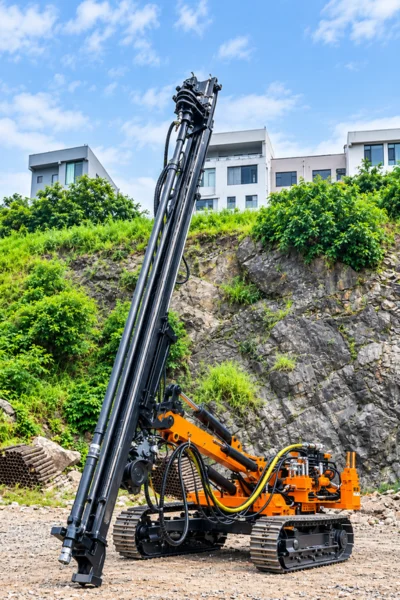
Crawler drilling rigs are built for drilling operations where site access, uneven terrain and frequent repositioning create challenges for conventional wheeled equipment. Mounted on a tracked undercarriage, the complete drilling unit can move across suitable unpaved and off-road working areas while carrying the drilling system as one integrated machine. Synergy Rigs Ghana supplies crawler drilling rigs for water boreholes, hard-rock drilling, quarry, mining and other field applications. Rig configurations can be selected according to geological formation, drilling depth, hole diameter, terrain, drilling method and project workload.
Crawler Drilling Rigs for Challenging Site Access
Reaching the drilling point can be a significant part of the project when work takes place away from established roads or across undeveloped ground. A crawler-mounted platform allows the drilling machine to travel within suitable site terrain and position closer to the required drilling location. The tracked arrangement can be particularly useful across rural areas, agricultural land, construction sites, remote locations and uneven work areas where conventional wheeled equipment may have limited mobility. Unlike a truck-mounted rig, which is primarily suited to road travel between accessible locations, a crawler rig places greater emphasis on movement and positioning within the worksite.
Crawler Rig Design and Operating Features
The crawler platform combines the undercarriage, drilling mast, feed system and other working components into a self-propelled drilling unit.
Compact Site Manoeuvrability
Depending on the dimensions of the machine, crawler configurations can provide practical manoeuvrability where working space or access routes are restricted.
Feed and Pullback System
The feed mechanism controls advancement of the drilling assembly, while pullback capacity supports drill-string retrieval and other drilling operations.
Integrated Drilling Platform
Mounting the drilling equipment directly on the tracked carrier allows movement, positioning and drilling functions to be handled by one machine.
Tracked Undercarriage
Crawler tracks provide continuous ground contact and allow the machine to move across suitable unpaved and uneven working surfaces.
Hydraulic Track Drive
Hydraulic track systems provide controlled movement when manoeuvring and positioning the machine around the drilling area.
Drilling Mast
The mast supports the drill string and provides the working travel required for drilling and rod-handling operations.
Applications Across Drilling Industries
Crawler rigs are used where drilling capability needs to be combined with practical movement around unpaved or difficult project environments.
Quarry and Rock Drilling
Crawler-mounted configurations can support selected quarry and rock-drilling operations where hard formations and repeated movement between drilling positions are involved.
Mining and Mineral Exploration
Depending on the rig specification and drilling method, crawler rigs can support exploration and mining projects where equipment needs to move across rough working areas.
Agricultural Water Development
Farm and irrigation projects may require drilling across open fields, plantations or rural land where tracked site mobility provides a practical advantage.
Water Borehole Drilling
Crawler rigs can support groundwater development where borehole locations are away from established roads or positioned across difficult-access terrain.
Construction and Geotechnical Drilling
Suitable crawler-mounted equipment can support selected site investigation, geotechnical and construction-related drilling applications.
Site and Drilling Requirements for Rig Selection
Selecting a crawler rig requires both the drilling specification and the conditions above ground to be considered.
Project Workload
For contractors drilling multiple holes, machine capacity should also be considered against expected operating hours, relocation frequency and repeated field use.
Drilling Depth and Hole Diameter
Target depth and required diameter influence mast capacity, feed and pullback requirements, drill rods, bits, hammers and other drilling equipment.
Terrain and Ground Conditions
Surface conditions, gradients, loose ground, obstacles and uneven terrain influence how effectively a particular machine can move and position on site.
Geological Formation
Expected geology helps determine whether the rig should be configured for rotary drilling, DTH drilling or another appropriate drilling arrangement.
Site Access
The route between the site entrance and drilling area should be assessed for machine width, ground conditions, gradients and other access limitations.
Working Space
Adequate space is required for machine positioning, mast operation, drilling activities and movement between drilling points.
Drilling Systems and Supporting Equipment
The crawler platform can support different drilling arrangements according to geology and project requirements.
01. DTH Crawler Configuration
For competent and hard-rock formations, the crawler rig can be configured with a DTH system using pneumatic impact at the bottom of the hole.
A typical setup can include:
- DTH hammer
- DTH drill bits
- Drill rods
- Air compressor
- Lubrication equipment
- Casing tools
02. Rotary Crawler Configuration
Where ground conditions suit rotary drilling, the equipment can be configured with appropriate rotary tooling and circulation equipment.
Depending on the selected method, this can include:
- Rotary drill bits
- Drill rods
- Mud pump
- Circulation equipment
- Casing equipment
03. Additional Drilling Components
Rod-handling equipment, hydraulic accessories, hoses, adapters and replacement wear components may also form part of the complete drilling package. Matching these components with the crawler rig helps ensure that the drilling system, tooling and supporting equipment are compatible with the intended work.
Why Choose Synergy Rigs Ghana for Crawler Drilling Rigs?
Rotary and DTH Configurations
The drilling system can be specified according to geological conditions rather than limiting the crawler platform to a single drilling method.
Equipment for Multiple Applications
Crawler drilling configurations can support groundwater, agriculture, construction, geotechnical, quarry, mining and exploration projects.
Practical On-Site Mobility
The tracked platform allows the machine to reposition within suitable work areas without depending entirely on prepared internal roads.
Equipment Matched to Site Conditions
Crawler configurations can be considered according to terrain, access conditions and the movement required within the drilling area.
Project-Based Rig Selection
Depth, hole diameter, formation, application and workload can be considered when determining the required rig capacity.
Compatible Drilling Components
Drill rods, bits, hammers, compressors, pumps and other supporting equipment can be matched with the selected machine.
Frequently Asked Questions About Crawler Drilling Rigs
1. Why choose a crawler rig instead of a truck-mounted rig?
Crawler rigs place greater emphasis on movement across difficult on-site terrain. Truck-mounted rigs are generally more focused on road travel between accessible project locations.
2. Can crawler drilling rigs be used for water boreholes?
Yes. Suitable crawler configurations can be used for water borehole drilling, particularly where the drilling location involves unpaved access or uneven terrain.
3. Are crawler drilling rigs suitable for uneven ground?
Crawler rigs can operate across many uneven and unpaved surfaces, although actual suitability depends on the machine specification, slope, ground stability and site conditions.
4. Can crawler rigs be configured for DTH drilling?
Yes. A suitable crawler platform can be configured with a DTH hammer, drill bits, drill rods and an appropriately matched air compressor for hard-rock drilling.
5. What determines the drilling depth of a crawler rig?
Working depth depends on the rig model, mast capacity, feed and pullback system, drill string, hole diameter, formation and drilling method.
6. How is a crawler drilling rig transported to a project?
Crawler tracks are primarily intended for movement within the working area. Transport to and from the project generally requires an appropriate carrier or transport arrangement based on the machine's dimensions and weight.
7. Can crawler drilling rigs be used in remote locations?
Yes, where access and terrain are suitable for the specific machine. Their tracked configuration can be useful for selected rural and remote drilling environments.
8. What information is needed before selecting a crawler drilling rig?
Provide the intended application, terrain, site access, target depth, hole diameter, geological formation, preferred drilling method and expected workload.